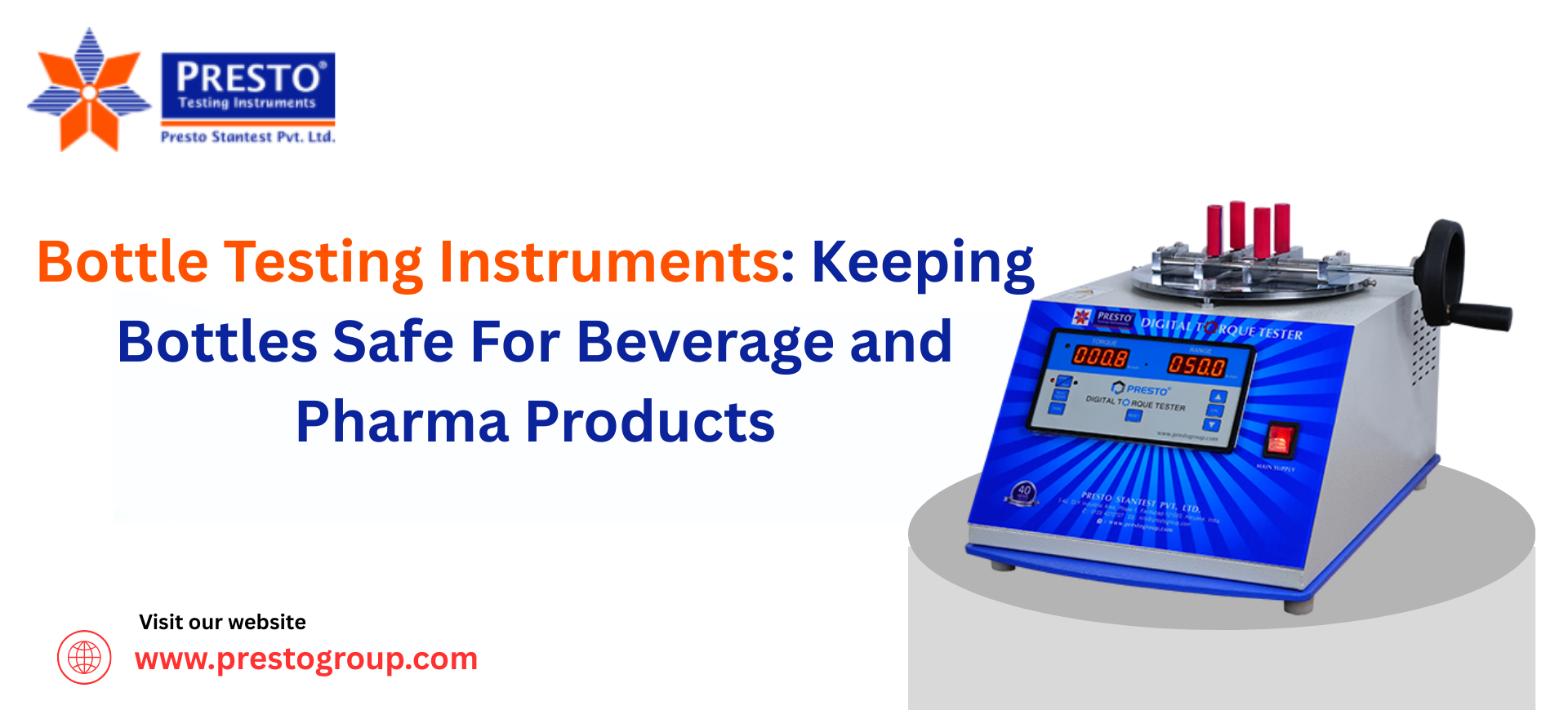
A skilled "Supplier of Bottle Testing Instruments" brings more than machines. They bring testing clarity, they assist teams in the application of the appropriate tests in the appropriate bottle, and they assist the bottle makers in terms of calibration and service.
Packaging seems to be straightforward, and the bottle applied in the beverage and pharmaceutical industries should be able to withstand pressure, transportation stress, stacking force, and daily handling force. Even a small structural flaw may lead to leakage, contamination, loss of products, or damaged brands.
In the case of manufacturers having thousands or even millions of bottles produced per day, the integrity of the packaging is essential. This is the place where the bottle testing instruments are needed. These high-precision tests are used to measure the strength of the bottles, their sealing efficiency, and their structural integrity prior to the bottles being transferred to the filling line or to the distribution chain.
Presto Instruments develops superior material testing tools and industrial testing equipment that assists manufacturers in maintaining uniform quality in packaging while at the same time conforming to global standards.
Bottle Testing Instruments are special laboratory testing equipment in the assessment of the mechanical and structural integrity of bottles manufactured using materials in the form of PET, glass, HDPE, and other plastic materials.
These are applied to simulate real-world stresses by using pressure, torque, compression, and impact forces to check the capability of a bottle design to safely survive manufacturing, filling, storage, and transport stresses.
Common bottle performance parameters evaluated include:
Internal pressure resistance
Cap closure torque strength
Seal integrity and leakage resistance
Top-load compression strength
Impact resistance during handling
They are used to help quality control teams find structural weaknesses when bottles are still in the mass production or packaging lines.
Packaging failure in high-volume markets, like beverages and pharmaceuticals, may be very expensive in financial and image aspects.
1. Product Safety
The leakage of a bottle can put drinks or medicines at risk of contamination or an environmental factor.
2. Quality Assurance
Testing maintains the stability of the product in terms of the strength of the bottles.
3. Regulatory Compliance
Pharmaceutical packaging should be of high quality because of the safety of patients.
4. Transportation Reliability
Bottles are required to withstand stacking pressure, vibration, and handling in the process of logistics.
With industrial testing machines being integrated into quality control processes, the manufacturers will be able to identify defects at the initial stage and avoid expensive recalls of the products.
A skilled "Supplier of Bottle Testing Instruments" brings more than machines. They bring testing clarity, they assist teams in the application of the appropriate tests in the appropriate bottle, and they assist the bottle makers in terms of calibration and service. Companies develop safer packaging habits when they achieve stable outputs.
A strong maker focuses on accuracy, as the smallest mistake in the pressure or torque measurement can result in incorrect quality choices. That is why the uniform test result readings and the consistent machine operation are sought by many brands. A skilled craftsman also comes up with tools that are compatible with a wide range of bottles. This assists beverage and pharma plants to test the new bottle designs with ease.
Sensors must be sharp and consistent.
Readings must be easy to read and store.
Clamps and holders should fit many bottle shapes.
The body of the machine should be steady during tests.
The test cycle must be simple so that teams can use it daily.
Service and calibration must be easy to access.
Plants that test bottles daily need instruments that work without trouble. They need tools that handle long hours, steady cycles, and large volumes.
Testing assists groups to identify defects prior to packing. One of the cracks, a thin strip of a wall, a weak bottom, or a loose top becomes clear on testing. As soon as the plant identifies the problem, they will be able to abort the batches and inspect the mold, material, or filling line. This reduces product waste, and it also cushions the company against complaints in the market.
Testing also assists the plants in satisfying the buyer expectations. Large soft drink brands tend to desire uniform bottle strength, while the pharma consumers desire close lids and powerful walls. Testing bottle instruments form designs that assist packaging crews to maintain bottles in the same position throughout the shifts.
High pressure inside carbonated bottles.
Load from stacking in godowns and trucks.
Sudden drops during line movement.
Long storage in hot or cold places.
Twisting force from users of all age groups.
Testing machines repeat these conditions many times, this helps companies study how bottles behave under stress. They can then change bottle design or cap type when required.
The powerful maker observes the behavior of bottles. When there is a change in the design of bottles, they update the machines; as a result, the PET bottles are getting lighter year after year, hence the PET is used instead of glass in pharma bottles. A dynamic producer adapts designs to such trends.
A professional fabricator also follows the clients in the choice of tests. There are plants, which require burst tests; some need torque tests more, and some need leak tests more. An excellent bottle testing instrument maker is the one that assists the plants to select the correct equipment regarding the correct product.
Presto Instruments offers highly dependable industrial testing tools that are set to assist quality teams achieve uniformity in their packaging performance and international compliance directives.
To request a quote, schedule a product demo, or discuss customized bottle testing solutions for your manufacturing facility, contact Presto today.
Q1. Why do beverage plants test bottles before filling?
Testing helps find weak bottles early. It cuts product loss and stops leakage problems during transport.
Q2. How often should pharma bottles be tested?
Plants usually test samples from every batch. The number depends on the bottle design, usage, and filling line.
Q3. Can one machine test all bottle shapes?
Many modern machines come with adjustable grips. They can test many shapes. Yet some very different shapes may need a special fixture.
Q4. Do lightweight bottles need more testing?
Light bottles often bend faster; they are tested more to check the wall strength and top load strength.
Q5. Does CAP testing really matter for users?
Yes. A loose cap can leak. A very tight cap can frustrate buyers. Testing helps brands set the right twist strength.
Our latest product catalogue cum company profile is now
available to download. Where should we send your FREE copy?